ES-01
Propellerless electrostatic thrust
No rotating parts — direct linear force generated inside an airtight casing.
SYS.02Flight systems and platforms
SYS.02Technology
Air is drawn in, forced through a perforated base, and the same power drives the vehicle on the ground via valve reversal. Track-wheel gear and an embedded parachute make landing terrain-independent.
The bottleneck of electric flight
Every eVTOL flying today uses external propellers — pedestrian hazard, urban noise limits, and the permit barriers that follow.
Motor spins, then gears, shafts and propellers convert rotation to thrust. Every link adds loss, weight and failure points.
"Flying car" concepts carry two separate systems for land and air — weight and cost double, range melts away.
Wheeled gear demands prepared pads; in an emergency landing, tipping and sinking risks are high.
Hayy's answer
ES-01
No rotating parts — direct linear force generated inside an airtight casing.
AB-02
Flight thrust and ground drive from the same unit, switched by valve reversal to a crank / track-wheel drivetrain.
SC-03
Thrust adjusted instantly through supply frequency and voltage — no gearbox, no throttle lag.
SL-04
Parachute case embedded in the track module at the center of gravity; track + wheel tolerate unprepared ground.
HM-05
The thrust cell (ref. 1–14) scales as a standalone product for drone and industrial platforms.
IP-06
Consolidated TR/EN specification with 18 reference parts, technical figures and patent drawings.
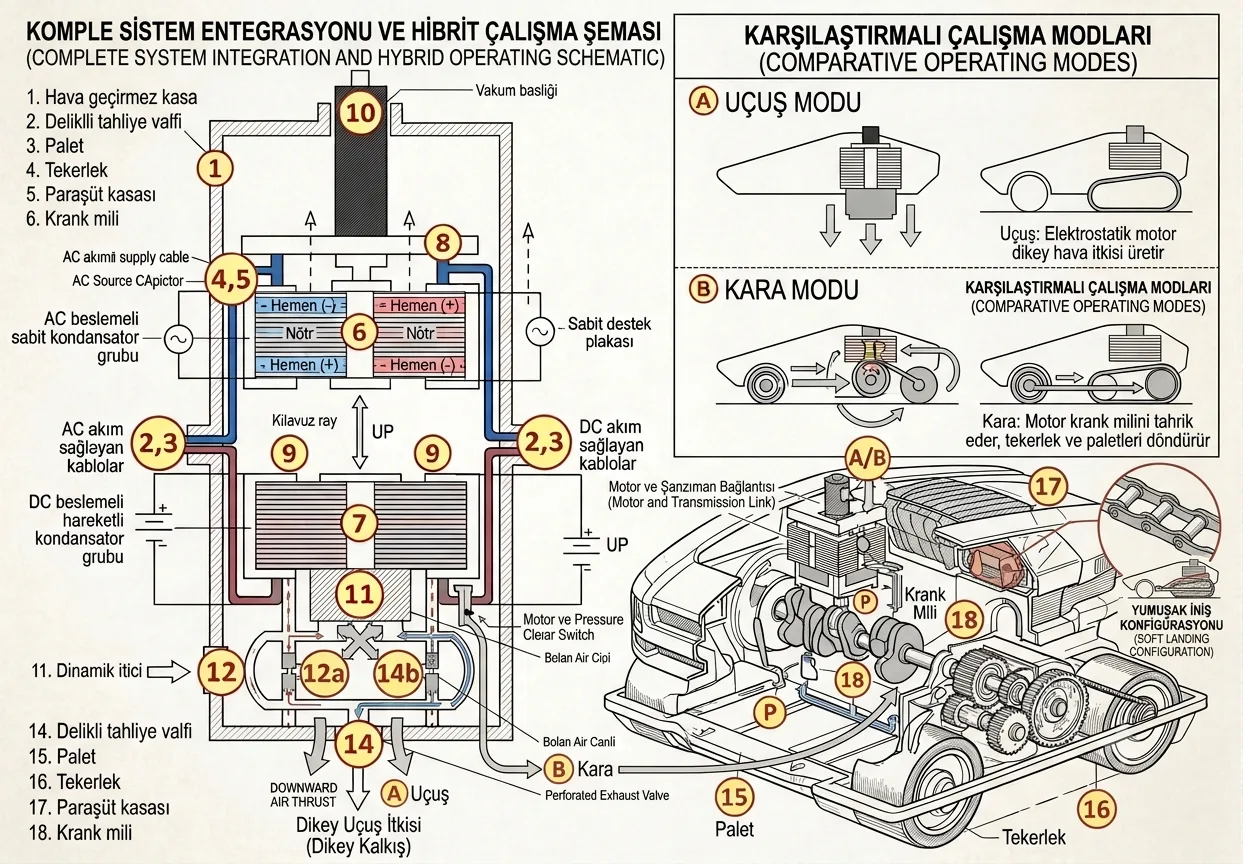
Status: the technology is at patent-application stage; performance values will be validated in the Phase 1 prototype program.
Technical figures & patents